
Longevity Mentorship Series 1 Recap from an Intern’s Perspective: Maximising Your Student Placement
My name is Aidan Frai, and I’m a final-semester Master of Clinical Exercise Physiology student at Deakin University, currently completing an internship at Longevity Exercise Physiology.
On Wednesday March 18th, Longevity kicked off the first session of the Mentorship Series for students. Led by senior leaders Ashleigh Mead, Georgia Wassall, and Ryan Hebron, the session was conversational and interactive — no slides, just real talk about how to maximise student placement.
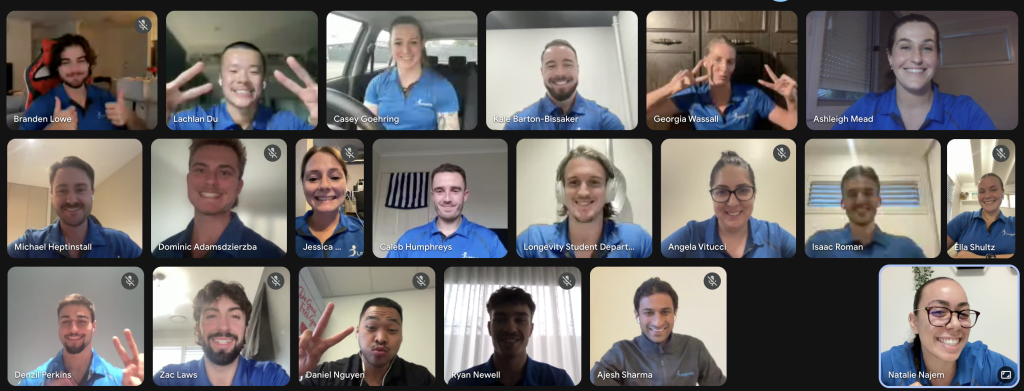
Here are the key themes and my personal takeaways from the night.
1. The “Heads Up” Approach
One of the most resonant themes of the evening, introduced by Ashleigh, was the “heads up” approach to life and work. In a clinical setting, it’s easy to keep your head down — focusing only on your notes or the immediate task in front of you. But as Ashleigh put it, if your head stays down, your opportunities stay out of sight.
Being “heads up” means:
- Scanning for opportunities. Looking beyond just the clinical skills to understand team culture, leadership styles, and how a business operates. Placement is your first real chance to compare different environments — public health, private health, mental health, cardiac rehab, neuro — and reflect on what resonates with you. Georgia spoke about how her placement experiences helped her identify what she valued in a team and a leader, reflections that ultimately led her to Longevity.
- Immersing yourself. Treating placement like a trial game for your actual career. You’re about to embark on a career that will hopefully span the rest of your working life, so use placement to learn how you’ll sustain yourself, manage your energy, and show up at your best every single day. Ashleigh framed health professionals as “mini-athletes” — unlike athletes who prepare for a single event or season, we need to perform consistently, day in, day out. That means thinking about sleep, meal prep, exercise, and how you balance external commitments alongside placement.
- Active listening. Using your eyes and ears to pick up on the nuances of client interaction that aren’t found in a textbook. This was framed as a minimum standard for session engagement, but the students who truly stand out are the ones who combine it with genuine curiosity about the people in front of them — being mindful of body language, staying upright and well-presented, and proactively asking clients questions in a way that shows real interest.
2. Finding Success in the “Moments in the Cracks”
Georgia introduced a concept that perfectly captures the extra-mile attitude: finding the moments in the cracks. This refers to the small, unplanned pockets of time — like the five minutes between sessions, or staying a few minutes after a shift — where genuine connection and learning happen. These aren’t scheduled opportunities. They’re serendipitous windows that students may possibly walk straight past.
This concept resonated deeply with me because it ties directly into the culture I’ve experienced at Longevity. Being a team player isn’t just about what you do during the structured parts of the day — it’s about who you are in the gaps.
To move from a “good” student to an “excellent” one:
- Show initiative. Don’t wait for instructions if your supervisor is busy. Ask what you can do to help — there’s always something you can be doing, and leaders notice when you find it without being asked.
- Build relationships. If the team invites you to lunch, go. These social points of connection are where you transition from a visitor to a team member. Better yet, proactively initiate culture — ask if the team ever catches up on a Friday night and express that you’d love to come.
- Go beyond clinical specs. An example shared on the night was a student who listened to a podcast a client had mentioned, just so they could discuss it in the next session. This kind of pursuit of excellence is what builds lasting client rapport and separates the good from the great.
3. Proactivity Over Reactivity
A key takeaway from my own notes during the call was the importance of shifting from reactivity to proactivity. This theme ran through almost every scenario and piece of advice shared on the night, but it’s most evident in how we handle feedback.
- Seek feedback early. Don’t wait for your mid-placement review. Ask after a session, “What could I have done better there?” A great student doesn’t wait for their supervisor to initiate the conversation — they come prepared with their own self-reflection.
- Lose the defensiveness. Understand that feedback is a tool for your growth, not a personal attack. When a supervisor offers constructive criticism, try to understand their angle and the “why” behind it.
- Apply the knowledge. This is the distinction that stuck with me most from the evening: knowledge alone isn’t power — applied knowledge is power. If your supervisor recommends reading the latest ACSM update, read it. But don’t stop there — follow up proactively, relate it to your current clients, and ask for further resources. That’s what tells a leader you’re coachable. And as Ashleigh put it, if you’re coachable, you’re employable.
4. Action Drives Clarity
Ryan closed with a powerful reminder for those of us feeling the weight of career uncertainty: action drives clarity. You don’t find your dream job by just thinking about it. You find clarity by saying yes to opportunities, attending mentorship sessions, returning that phone call, and immersing yourself in the process — even when you’re not sure where it leads.
Whether you want to be on the floor in a gym or conducting groundbreaking research, the habits you build on placement — professionalism, preparation, and a growth mindset — will be the foundation of your success. The person who lands the dream job is the one who takes steps, not the one who overthinks.
My Key Takeaway and Commitment Moving Forward
Knowledge alone is not the goal — applied knowledge is.
The biggest shift for me is recognising that growth doesn’t just happen in structured learning — it happens in the gaps. The small conversations, the extra questions, the moments you could easily rush past.
Rather than focusing on one task to the next, I’m choosing to slow down, stay present, and use those in-between moments to build relationships, support the team, and keep improving every day.
We’d love to see you take part in our 2026 Longevity Mentorship Series!
To RSVP for the next one on April 15th,
Call us at Longevity Exercise Physiology Ascot Vale, Aspley, Broadbeach, Casey, Castle Hill, Coburg, Deagon, Drummoyne, Edgecliff, Five Dock, Gladesville, Gungahlin, Kingsgrove, Liverpool, Macarthur Campbelltown, Marrickville, Neutral Bay, Penrith, Pymble, Pyrmont, Randwick, Rhodes, Rosebery, Springfield, Yamanto today on 1300 964 002 to speak directly to one of our Senior Exercise Physiologists, or, for more opportunities, email students@longevitypt.com.au
Written by Aidan Frai (Intern)